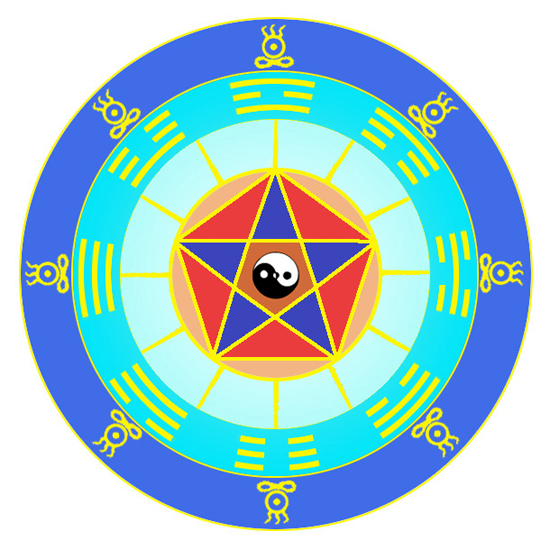
Decoding the Principles of the Universe
The Eight Grand Laws of the Universe
by Zhang Hongbao
The Kylin is an auspicious symbol of the Chinese people. On the appearance, it has the dragon’s head, the deer’s antlers, the boar’s nose, the snake’s skin, the tiger’s back, the bear’s waist, the horse’s hoofs, and the lion’s tail. It reminds people of everything but resembles nothing. Representing the quintessence of various animals, this symbol synthesizes all that is good in the universe.
By the same token, the Tianhua Culture is a synthesis of the Chinese civilization and the Western civilization, the ancient culture and the modern science, the philosophers’ theories and the wisdom of the ordinary people; it contains the cream of Buddhism, Taoism, Confucianism, traditional Chinese medicine and martial arts, and has also adopted some fruits of the most recent scientific researches. The Tianhua Culture offers a series of self-contained, systemic expositions in the areas of literature, history, philosophy, music studies, mathematics, physics, chemistry, astronomy, geography, biology, politics, economics, and strategies. The Tianhua Culture is the continuation and development of the human culture. Also resembling everything and nothing at the same time, the Tianhua Culture is a unique culture that has synthesized the essence of numerous schools and sciences.
The Tianhua Culture consists of eight major systems:
1. Tianhua Philosophy;
2. Tianhua Life Science;
3. Tianhua Special Medicine
4. Tianhua Esthetics and Arts
5. Tianhua Pedagogy;
6. Tianhua Studies of Entrepreneurship
7. Tianhua Studies of Etiquettes and Protocols
8. Tianhua Studies of Life Cultivation
As the worldview and methodology of the Tianhua Culture, Tianhua philosophy has inhered, rearranged and absorbed the essence of the tradition of human epistemology and, on this basis, reached a higher level of understanding through the discovery of the eight grand laws on the operation, development and change of everything in the universe, animate or inanimate, as well as through advances in epistemology, morality, ethics, historical perspective, and theory of human nature. As the theoretical basis and quintessence of the Tianhua Culture, Tianhua philosophy is intrinsic to the creativity and development of the Tianhua Culture. The other major systems of the Tianhua Culture are not more than the extensions, elaborations and specific applications of Tianhua philosophy.
What exactly are the eight grand laws in the system of Tianhua philosophy? They are
First: The Basic Law of Yin and Yang;
Second: The Law of Counterbalance of Five Elements;
Third: The Law of Integrity of Humans and Nature;
Fourth: The Law of Golden Mean
Fifth: The Law of Causality
Sixth: The Law of Auto-Harmony of the Universe
Seventh: The Law of Exchange Between Quality and Quantity
Eighth: The Law of Pulsation and Spiral Movement
Copyright , All rights reserved